

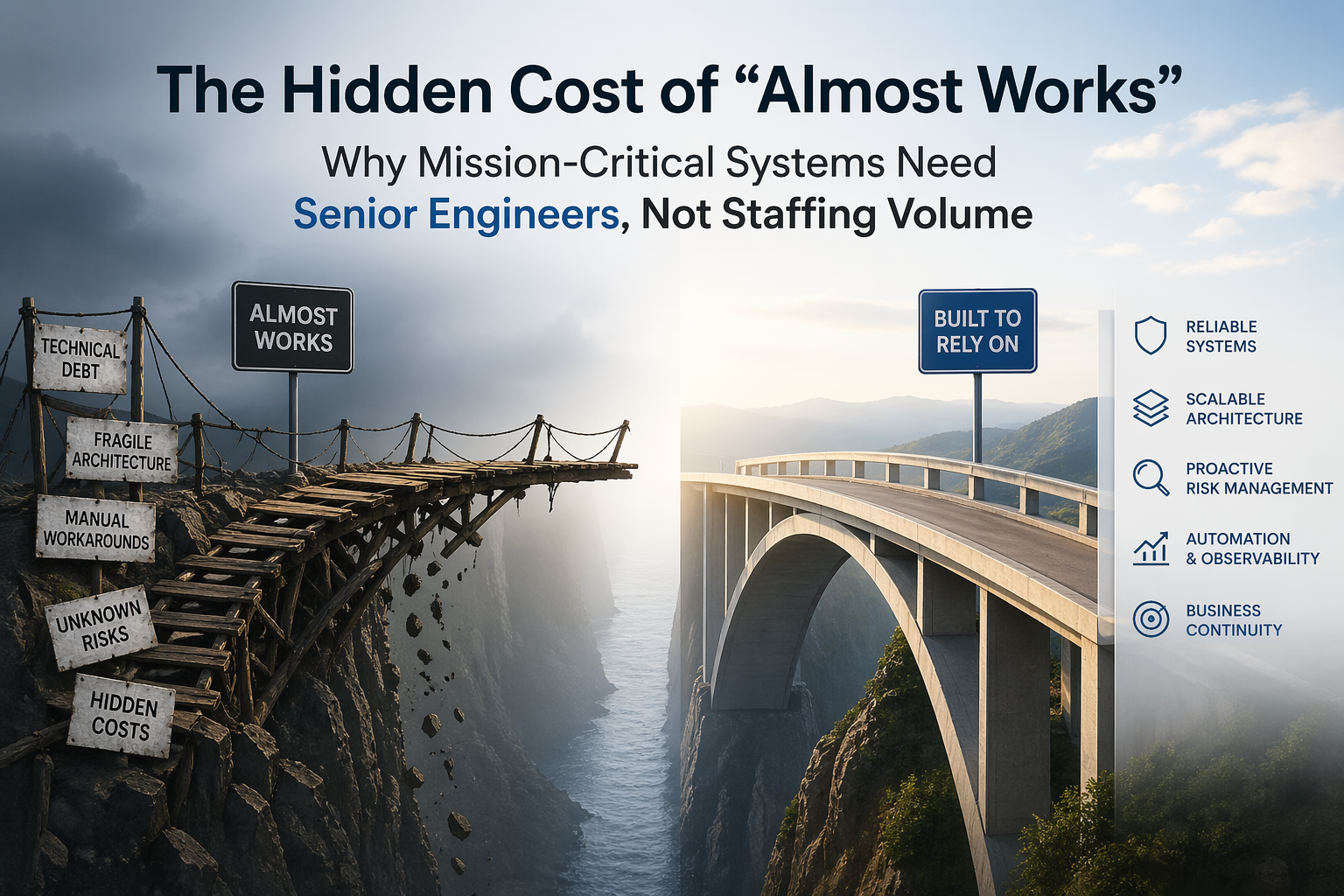
There is a category of software that cannot afford the luxury of "mostly fine."
These are the systems that keep operations moving, revenue flowing, customers transacting, clinicians informed, logistics synchronized, auditors satisfied, and executive teams sleeping at night. They sit underneath business continuity. They shape operational confidence. When they fail, the damage is rarely confined to a bug ticket.
And yet many of these systems are still built using a model optimized for apparent efficiency rather than actual reliability: add more people, lower the day rate, spread ownership across a mixed-seniority team, and hope process compensates for experience.
That model can look attractive in procurement. It can look scalable in slide decks. It can even look productive in the first few months.
But in mission-critical environments, the real cost does not show up in the staffing plan. It shows up later, in the expensive space between "it shipped" and "it works under pressure."
That is the hidden cost of almost works.
"Almost Works" Is Not a Small Problem
Most serious software failures do not begin as spectacular collapses. They begin as tolerated weaknesses.
An integration path that works for the standard case but breaks on exception handling.
A workflow that supports the happy path but forces manual intervention when data arrives out of order.
A service that performs well in test conditions but degrades under real concurrency.
A reporting layer that is technically correct but impossible for operators to trust.
None of these issues sound dramatic on their own. That is exactly why they persist.
Teams learn to route around them. Business users invent compensating behaviors. Support functions absorb the friction. Leaders tell themselves the system is stable enough because it remains operational.
But "stable enough" is often just delayed liability.
In mission-critical systems, small defects are not isolated. They multiply across workflows, dependencies, compliance obligations, and decision chains. One weak architectural choice can create years of downstream cost in maintenance, performance, onboarding, support burden, and change resistance.
This is why delivery quality cannot be measured only by whether software goes live. The better question is: what kind of future did we just ship?
The Procurement Trap: Cheap Capacity, Expensive Outcomes
Organizations under pressure to modernize often get pulled into a familiar tradeoff: more people for less money versus fewer, more experienced people at a higher rate.
On paper, volume usually wins.
More developers suggest more momentum. A blended team looks cost-efficient. Junior-heavy delivery models promise scalability. Procurement teams can compare rates line by line and feel they are managing spend responsibly.
But mission-critical delivery does not fail because there were too few hands on keyboards. It fails because the wrong decisions were made too early, too late, or without enough context.
Architecture was treated as a preliminary phase instead of a living discipline.
Technical debt was accepted before business risk was understood.
Edge cases were discovered in production instead of designed for up front.
Ownership became diffuse.
Escalations multiplied.
Simple changes became dangerous.
These are not headcount problems. They are judgment problems.
And judgment is one of the few things in software that does not scale linearly by adding more people.
A senior engineer does more than write better code. They reduce ambiguity earlier. They recognize failure patterns sooner. They make cleaner tradeoffs under pressure. They understand when a shortcut is harmless and when it quietly compromises the entire system.
That is not premium polish. That is risk control.
Mission-Critical Systems Need Compression of Uncertainty
Every important software initiative begins with uncertainty.
Requirements evolve. Stakeholders disagree. Legacy constraints appear late. Integrations are underspecified. Operational realities emerge only after contact with the business. Timelines shift. Security, compliance, and scale concerns surface unevenly.
The core challenge is not just building the system. It is compressing uncertainty fast enough that the organization can move with confidence.
This is where senior engineering changes the economics of delivery.
Experienced engineers reduce the number of unknowns that survive into later phases. They ask sharper questions. They detect structural weaknesses earlier. They turn fuzzy business language into technical decisions with fewer translation errors. They identify what must be proven first and what can safely wait.
That matters because unresolved uncertainty gets more expensive over time.
A misunderstanding caught in discovery is a conversation.
The same misunderstanding caught during implementation is rework.
Caught during go-live, it becomes delay.
Caught after launch, it becomes operational risk.
In other words, seniority is not just about execution quality. It is about the speed and accuracy with which a team turns uncertainty into informed action.
Why We Built Amexis Around Senior-Only Delivery
At Amexis, we made a deliberate choice: zero juniors.
Not because junior engineers lack value. Every strong engineer starts somewhere. But our role in the market is specific. We are not designed to maximize bench utilization or provide low-cost staffing layers. We are built for organizations that need expert engineering on systems where mistakes carry real consequences.
That changes how we hire, how we structure teams, and how we engage with clients.
Senior-only delivery means our clients do not spend the first half of an engagement subsidizing a learning curve. It means the people in the room can interrogate assumptions, challenge unclear requirements, and carry technical accountability from architecture through implementation. It means fewer translation layers between strategy and execution. It means the person building the solution can also evaluate whether the solution should be built that way at all.
This model is not right for every project. It is not meant to be.
If the goal is to maximize cheap capacity, there are many providers who can do that well.
If the goal is to ship quickly with manageable consequences for imperfection, there are situations where blended teams may be perfectly reasonable.
But if the system is central to operations, compliance, revenue, customer trust, or long-term transformation, the cost logic changes. In those cases, the cheapest team is often the one that prevents expensive mistakes from ever becoming part of the baseline.
What Senior Engineers Actually Protect You From
The value of senior engineering is sometimes described too vaguely, as if it were simply a matter of craftsmanship or leadership presence. In reality, its impact is concrete.
Senior engineers protect organizations from:
1. Structural mistakes that are hard to reverse
Poor service boundaries, brittle integrations, weak data models, and badly chosen abstractions can survive for years. Once embedded, they tax every roadmap decision that follows.
2. False progress
Velocity can look healthy while risk quietly accumulates. Senior teams are better at distinguishing movement from meaningful advancement.
3. Fragile delivery plans
Experienced engineers know where plans tend to break, what dependencies are underestimated, and which assumptions need validation before commitments are made.
4. Operational surprises
Production is where theory meets consequence. Senior practitioners design with supportability, observability, resilience, and recovery in mind from the beginning.
5. Communication loss between business and engineering
Mission-critical work often fails in translation. Senior engineers narrow the gap between executive intent, user reality, and technical implementation.
6. Technical debt disguised as pragmatism
Not every shortcut is dangerous. The problem is that many teams cannot reliably tell the difference. Senior judgment helps separate strategic compromise from future failure.
Brand Trust Is Built in the Back End Too
There is another point that companies sometimes underestimate: system quality is not just an engineering issue. It is a brand issue.
Customers may never see your architecture diagrams. They will never care how elegantly your services are orchestrated. But they absolutely experience the consequences of engineering quality.
They feel it when transactions fail.
They feel it when service teams cannot access accurate information.
They feel it when delivery promises slip because internal systems cannot support change.
They feel it when a platform becomes unpredictable at the exact moment trust matters most.
For that reason, mission-critical engineering is not merely a technical investment. It is an expression of institutional seriousness.
Organizations that treat critical systems casually eventually communicate something unintentional to the market: that reliability is negotiable.
The organizations that build them well communicate the opposite. They create trust not through claims, but through consistent performance under real conditions.
The Better Question to Ask a Technology Partner
When evaluating an engineering partner, many organizations ask versions of the wrong question.
How many people can you assign?
How quickly can you start?
What is your blended rate?
Can you scale the team next quarter?
These questions are understandable. They are also incomplete.
For mission-critical work, the more important questions are:
Who will make the hard decisions when requirements get messy?
Who will recognize architectural risk before it becomes embedded?
Who will challenge us when our assumptions are weak?
Who can operate credibly with both technical depth and business consequence in mind?
Who stays accountable when the easy path is the dangerous one?
That is the level at which real delivery quality is decided.
Why This Matters Now
The pressure on organizations is increasing from both sides.
On one side, leadership teams are expected to modernize faster, integrate more systems, use data more intelligently, improve customer experience, and digitize core operations without disrupting the business.
On the other, the tolerance for failure is shrinking.
Regulatory expectations are tighter. Operational environments are more interconnected. Customers are less forgiving. Internal complexity is higher. Legacy modernization is colliding with AI initiatives, cloud transitions, cybersecurity demands, and budget scrutiny.
In that environment, "good enough engineering" is becoming a dangerous management assumption.
The companies that will move best through this era are not necessarily the ones with the largest vendor rosters or the lowest development cost per hour. They are the ones that understand where expertise compounds.
Mission-critical systems are one of those places.
A Different Kind of Partner
At Amexis, we do not position ourselves as a general-purpose software supplier. We are a senior engineering partner for mission-critical systems.
That means we are most valuable where the work is consequential, the margin for error is low, and the cost of vague ownership is high.
We help organizations design, build, modernize, and stabilize systems that need to stand up not only in demos, but in reality.
Our model is simple to describe and harder to imitate:
expert engineering, zero juniors, focused where reliability and clarity matter most.
It is a choice rooted in a belief that many organizations already suspect is true from experience:
when software truly matters, the team matters more than the slide deck.
If You Are Carrying Critical Systems, Start Here
If you are responsible for a platform, product, or transformation initiative that the business cannot afford to get wrong, it may be time to ask a sharper question than "How fast can we staff this?"
Ask instead: "What would it cost us to build this with the wrong level of judgment?"
That is often where the real business case begins.
And that is where Amexis is built to help.